
A Proclamation
The Boston Society for the Preservation of Revolutionary History, having been recently established in this year of 1776, wishes to acquaint the Publick of a new footway to commemorate the events concerning the Independence of this New Nation, to preserve this history for the many generations to come, including those foolish individuals who will traverse this Vital Route 250 years hence and publish humorous Accounts of such Journeys.
It’s hard to fully grasp how Boston has influenced American history, culture, and society until you experience the Freedom Trail. It starts across the street from the Dunkin’ Donuts on the edge of Beacon Hill and ends near the Dunkin’ Donuts at Bunker Hill Mall. The route traverses some of Boston’s most historic and Dunkin’-filled neighborhoods.
On Monday, Sept. 14, 2026,1,2 I laced up my running shoes and set out to explore the trail for myself. What did I see? What did I feel? What inane witty observations await you, dear victim reader, in this blog post?
Let’s find out.
Boston Common
The Freedom Trail begins in Boston Common, one of few public parks in the United States named after a sitcom. Boston Common debuted in 1996 and only ran for two seasons.3 The park is more than 400 years old. I assume this timeline inconsistency has already been retconned in the MCU.4
The trail itself is marked by a thin red line of bricks, punctuated by a few plaques embedded in the ground. This made the trail very easy to follow as long as I didn’t want to look at anything at eye level (i.e., not easy at all).
I hear you saying, “I can follow a line without looking down all the time.” I thought I could too, but the sidewalks are uneven and poorly paved in quite a few places. I assume this is an attempt to make the pathway historically accurate. Colonists in the 1770s smashed the sidewalks so as to make British troops trip over bricks and roll their ankles.5

Beacon Hill and Downtown
Boston Common is everything you want in a city park: a mixture of old and new, activities and areas for everyone, and lots of places to just sit down and people-watch. I was tempted to join the tai chi group for a moment, but decided against it because I possess all the grace and poise of a drunken walrus.
The trail led me out of the park, past the Massachusetts State House, and into the Granary Burying Ground, proving (in reverse order) Benjamin Franklin’s adage that nothing is certain in life but death and taxes.


Downtown, Continued
Let’s keep running.


A Serious Aside
The Old State House was the site of the Boston Massacre, which I do not wish to make light of. Instead, I will share a story from high school.
My AP U.S. History teacher offered this mnemonic to help us remember the name of the first person killed in the massacre: “If the snow is crispy and someone tried to sneak up and attack you, you’d hear the crunch,” she said.
The victim’s name was Crispus Attucks.
Attucks was Black—he had both African and Native American ancestry—and, for many years, he was minimized in the lily-white retellings of Revolutionary history.
I am many years removed from that class, and I have never forgotten Attucks’ name or story. I still associate both with the sound of crunching snow.

Faneuil Hall
The trail leads next to Faneuil Hall—the onetime Cradle of Liberty that now anchors a tourist trap.
Faneuil Hall, Quincy Market, and some newer buildings comprise Faneuil Hall Marketplace. It’s where I found the Sephora where Betsy Ross learned to do her trademark smoky eye and the souvenir shop where Sam Adams bought his famous “Wicked Pissah Drinking Team” T-shirt.
The thing I most enjoyed in this area was Wild Benches of Hope, a temporary art installation.6


After hanging out with my bronze animal pals, I ran east to get to …
The North End
The North End is a Dunkin’ desert, which means nothing of historical significance must have happened there.
I kid, I kid. Don’t @ me about this, historians.7
This area, Boston’s Little Italy, is known for cannoli, not donuts. It’s where you’ll find that famous cannoli place that has a long line of tourists, which is down the street from the slightly less famous one that everyone says is much better, but turns out to be another disappointing tourist trap.
North End : Cannoli :: French Quarter : Beignets
Paul Revere lived in the North End, but I do not know which cannoli place he preferred.


Charlestown
After passing another graveyard (Copp’s Hill Burying Ground) and crossing the Bill Russell Bridge, I reached Charlestown. I saw a park named for (surprise surprise) Paul Revere on my left and skipped it, despite its impressive 4.6-star rating on Google, because the last stop on the Freedom Trail was in sight—and it had a 4.7-star rating!
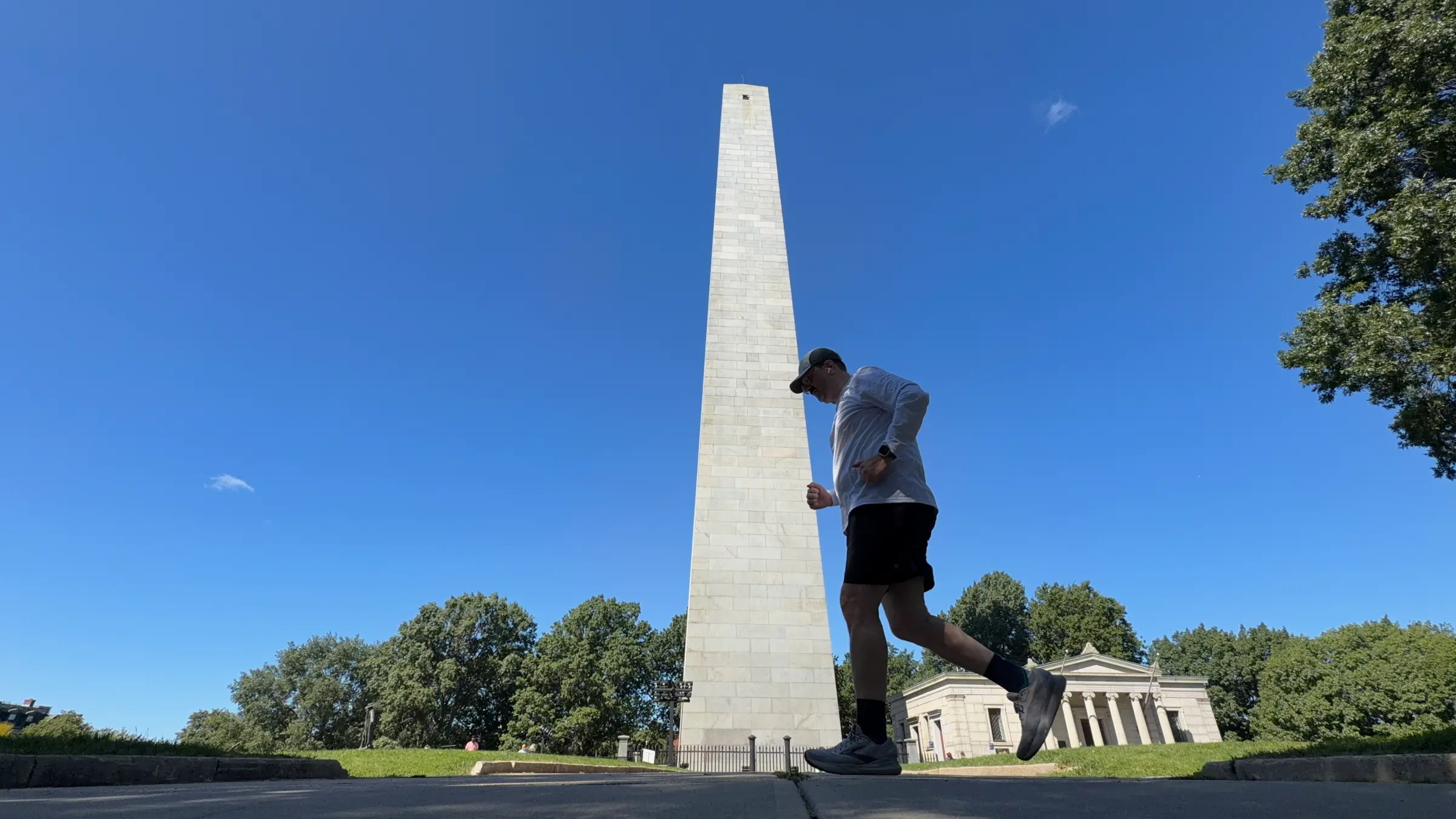
The Bunker Hill Monument is a 221-foot (67-meter) granite obelisk at the top of Breed’s Hill.8 It sits in the middle of a mostly treeless park, aligned perfectly with a single statue on one side and a small building on the other. It’s a drill sergeant of a park: straight lines, crisp right angles, flat surfaces, no adornment.
I did a lap or two around the monument, wishing I had started my run here, at this solemn reminder of the Revolutionary War, and ended up amid the energy and liveliness of Boston Common. Oh well. Next time, I guess.
After considering, and quickly rejecting, the idea of climbing the steps to the top of the monument. I decided it was time to return to the hotel.
I pressed Stop Workout on my watch and walked down the stairs. It was only then that I saw my first large Freedom Trail sign and map.
It was placed, conveniently, at eye level.


Heading Back to the Hotel
On the T back to my hotel, there was a little time to reflect.
The run was enjoyable, but I didn’t get much out of it besides some exercise and fodder for a blog post.
That’s my fault, not Boston’s or the Freedom Trail’s.
In places like Berlin, Prague, and Lisbon, I had guides to lead the way and discuss history with. In Boston, I only had a red line to follow and my rusty knowledge of Revolutionary history.
If I do a Boston run again, I’ll get a guide or join a running tour. Or I’ll go solo but follow my own route, not the one laid out for me by the Boston Society for the Preservation of Revolutionary History in 1776.
I got off the T at the Chinatown station, walked to the hotel, and collapsed in bed. It was time for a shower. It was time for a little relaxation. It was time for caffeine and a snack.
If only Boston had a place where you can buy coffee and donuts.
By the Numbers
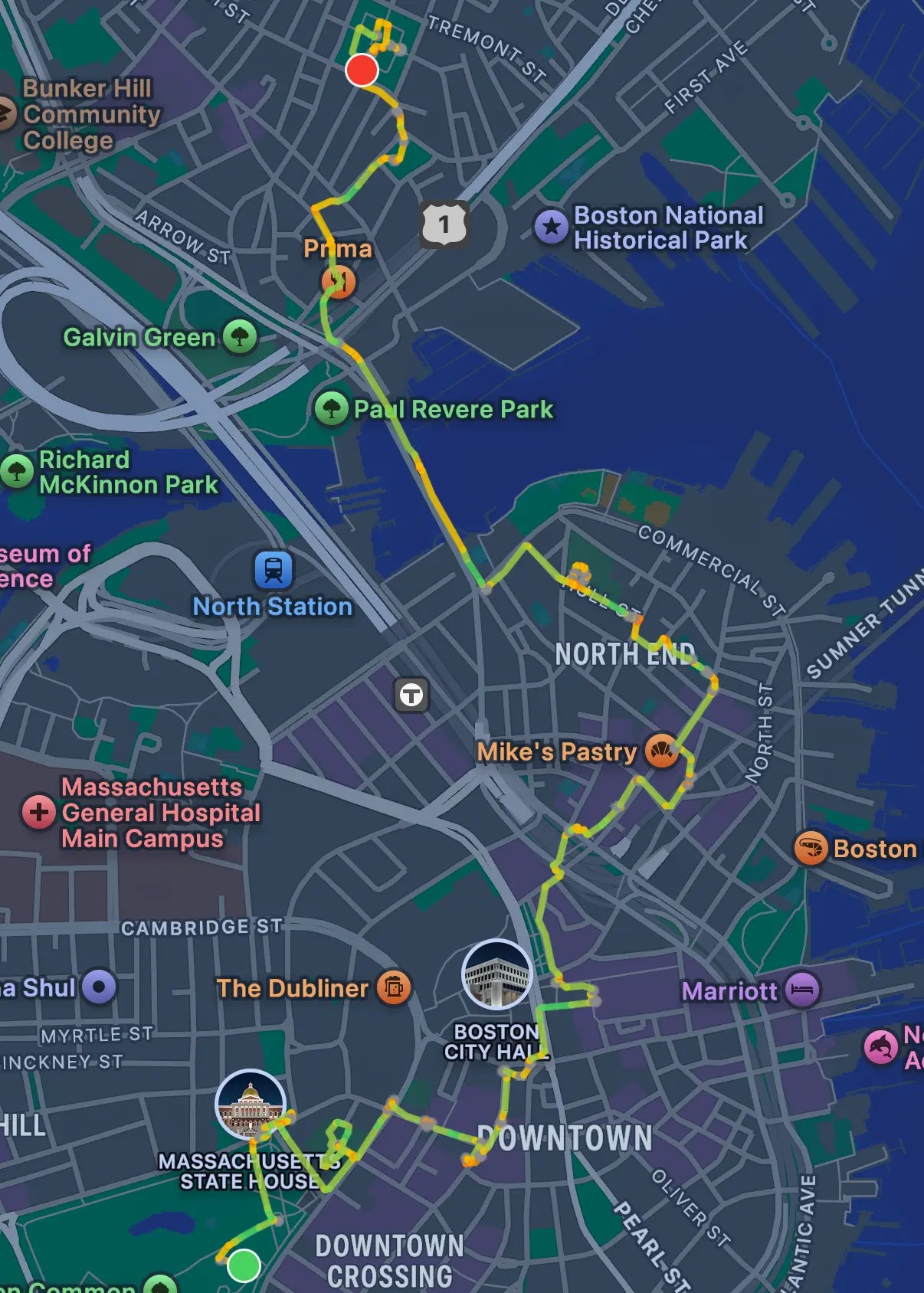
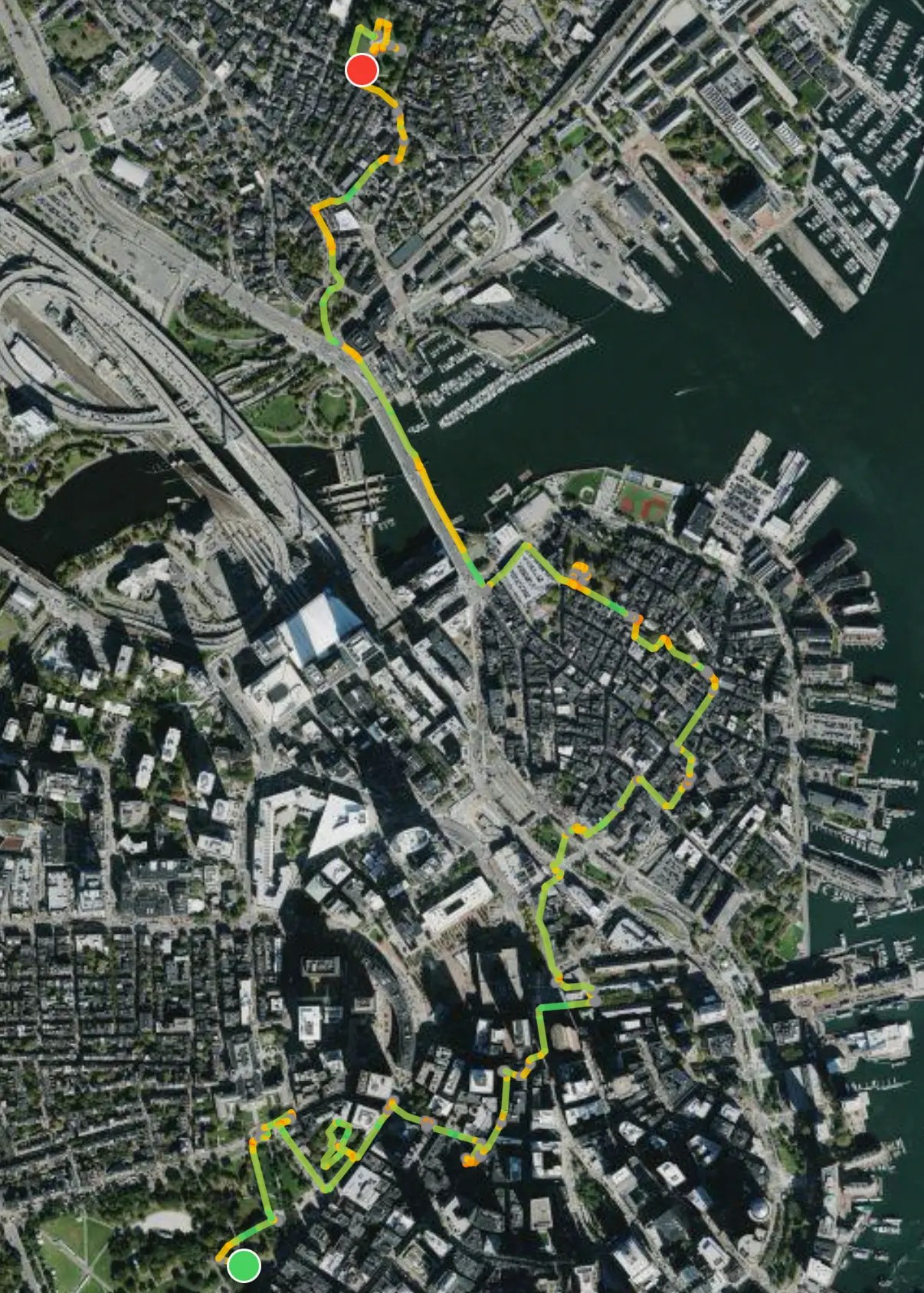
- Distance: 3.29 miles (5.29 km)
- Elevation gain: 458 ft (140 m)
- Temperature: 67° F (292.6° Kelvin)
- Number of steps to top of Bunker Hill Monument: 294
- Number of steps I climbed: 0
- Number of times Paul Revere is mentioned in this post, excluding this one: 7
- Number of times Dunkin’ is mentioned in this post, excluding this one: 4
We Hold These Footnotes to Be Self-Evident
- This was 12 score and 10 years after our fathers brought forth on this continent, a new nation, conceived in Liberty, and dedicated to the proposition that all men are created equal. ↩︎
- This was three score and two days before I actually got around to writing and publishing this post. ↩︎
- Anthony Clark, the star of Boston Common, passed away while I was drafting this post. ↩︎
- Massachusetts Cinematic Universe ↩︎
- This is a well-established historical fact that I have just made up. ↩︎
- I couldn’t shake the feeling that I had seen these sculptures before. Turns out I hadn’t—but they looked familiar because the Complimentary Spouse and I had seen an installation by the same artists at Spitalfields Market four years ago. ↩︎
- In fact, don’t @ me about any of the historical errors—deliberate or intentional—in this post. ↩︎
- I hear you asking, “Shouldn’t this be Bunker Hill?” That’s what I thought too, but apparently it’s Breed’s Hill. ↩︎
- They’re wrong. It does. ↩︎